
)
Lightning forecast alerts provide up to 60 minutes of lead time. Wind speed and gust alerts extend up to 72 hours ahead. Operations teams gain the window to enact protocols rather than respond to events already underway.
)
Real-time severe weather monitoring, lightning alerts, and winter surface condition forecasting for airports and ground operations teams worldwide.
)
Weather determines when ramp operations stop, when they resume, and how runways are maintained between storms. The cost of getting those decisions wrong is measured in safety incidents, flight delays, and wasted resources.
Xweather delivers real-time severe weather monitoring, automated alerting, and sensor-driven surface condition forecasts that let airport operations teams act on data rather than caution. Two capabilities cover the most time-critical weather problems in aviation: Xweather Protect for lightning and severe weather alerting, and Xweather Horizon for winter surface management.
Backed by Vaisala's heritage in aviation weather systems deployed in more than 170 countries, Xweather combines proven sensor technology with operational software from a single provider.
Real-time lightning alerts and all-clear notifications let ground crews know exactly when to stop and when to resume, based on data from the world's most accurate lightning detection network.
Sensor data from runways, taxiways, and apron areas combined with 72-hour surface condition forecasts give winter maintenance teams the precision to treat only when needed, minimizing operational disruption.
Vaisala's aviation weather systems provide windshear alerting, visibility reporting, and high-resolution nowcasting for approach corridors and runway environments.
:focal(1449x3388:1450x3389))
Xweather analyzed a decade of global lightning data to assess strike frequency, risk duration, and operational impact at the 50 busiest airports worldwide.
The configuration of alert distance and all-clear time directly determines how many lightning risk episodes an airport experiences, and how long they last.
The report ranks all 50 airports by lightning risk, each with a detailed profile covering strike density, seasonal patterns, and estimated ramp closure hours.
:focal(1683x3186:1684x3187))







)
Xweather addresses two of the most operationally disruptive weather challenges in aviation: severe weather that stops ground operations, and winter conditions that compromise runway surfaces. Both are served by purpose-built products that integrate real-time detection, automated alerting, and operational forecasting.
Lightning forecast alerts provide up to 60 minutes of lead time. Wind speed and gust alerts extend up to 72 hours ahead. Operations teams gain the window to enact protocols rather than respond to events already underway.
)
All-clear notifications confirm when the threat has passed, enabling ground crews to resume without manual weather checks. Every minute of avoided false-alarm downtime is recovered operational capacity.
)
On-site sensor data drives surface condition forecasts that let winter maintenance teams treat at the right time, minimizing the operational disruption of delaying takeoffs and landings while runways are cleared, and conserving resources without compromising safety.
)
Xweather Protect is cloud-based, drawing on the global Xweather Lightning Network for lightning detection and severe weather alerting. No on-site detection hardware is required.
Airport operations and ground handling teams
When lightning threatens an airport, ground operations stop. In the US, the FAA recommends halting operations when lightning is within five miles and resuming 10 minutes after the last event. The challenge is ensuring the safety of personnel while minimizing unnecessary downtime. Without accurate detection, teams default to conservative protocols that extend closures beyond what conditions require.
Xweather Protect delivers real-time lightning detection and forecast alerts for defined airport zones. Three configurable alert levels (information, warning, alarm) let teams respond proportionally to approaching threats. All-clear notifications confirm when conditions are safe to resume. Alerts are delivered by email and SMS. Airports can also connect their own on-site devices (sirens, flashing lights, display screens) to receive alerts directly. No on-site detection hardware is required.
Ground operations resume faster, based on detection data rather than conservative estimates
Alert distance and all-clear timing are configurable to match each airport's operational protocols
Sufficient lead time to enact safety protocols and protect ground crews before lightning reaches the airfield
)
Standard weather forecasts describe atmospheric conditions but not what is happening on the runway surface. Xweather Horizon uses sensor data from installations at your airport to generate dedicated surface forecasts covering temperature, accumulation, and grip, giving maintenance teams the data to make the right call in marginal conditions.
Plan maintenance operations with a three-day forecast horizon. Surface temperature, grip, and condition forecasts indicate when ice, snow, or frost will form and when conditions will recover.
Surface temperature, grip, and condition data let maintenance teams distinguish between conditions that need treatment and marginal conditions that do not. The benefit is in the cases where crews would normally go out as a precaution but the data confirms treatment is unnecessary, avoiding disruption to operations.
Configure thresholds for ice formation, temperature drops, or grip deterioration. Teams are notified immediately when conditions breach those limits.
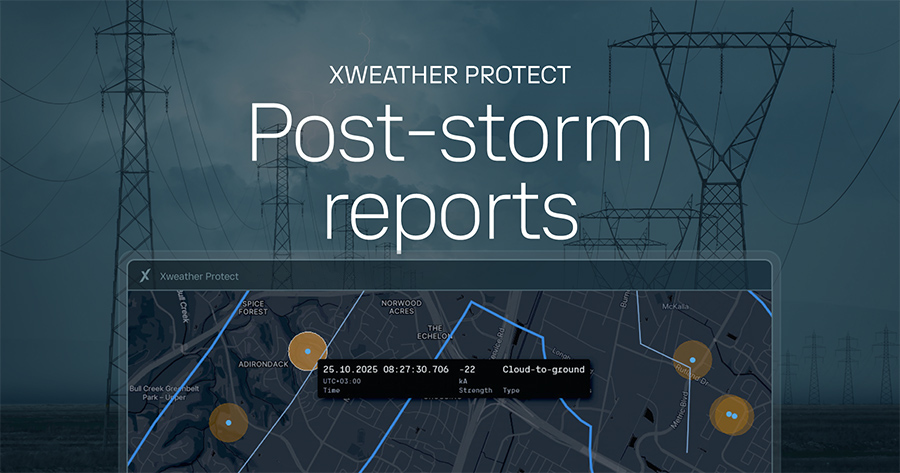
Xweather Protect gives aviation operations teams a full picture of lightning risk: where storms are now, where they're heading, and when conditions are clear. It's the data behind faster ramp decisions and fewer unnecessary delays.
of thunderstorms detected worldwide
lightning forecast lead time for approaching storms
median location accuracy in the U.S.
lightning events detected annually
Real-time severe weather monitoring and automated alerting for airport operations. Lightning detection, hail and wind forecasts, configurable alert zones, all-clear notifications, and post-storm reporting, with no on-site hardware required.
Winter surface management for airports. Sensor-driven runway and taxiway forecasts up to 72 hours ahead, with automated alerts for ice formation, temperature drops, and grip deterioration.
The global lightning detection network behind Xweather's severe weather products. Detects 99.9% of thunderstorms worldwide with median location accuracy of 84 meters in the US. The data foundation for lightning alerting, hail forecasting, and post-storm analysis.
Integrate lightning, severe weather, and road weather data directly into airport operations platforms via a flexible RESTful API. Includes lightning endpoints, severe weather alerts, and aviation-relevant weather parameters.
From real-time lightning alerting to runway surface forecasting, Xweather gives aviation teams the weather intelligence to act earlier and operate with confidence.
:focal(1494x1335:1495x1336))
)
)