
)







)
)
)
)
)
)
)

)
)
)
)
The complete lightning statistics by Xweather
The Annual Lightning Report 2025
Visual created with Xweather Live
Discover 2025's most compelling lightning data and unique industry insights. Brought to you by Vaisala Xweather, the global leader in lightning detection, trusted by governments, meteorological agencies, and businesses to protect what matters most.
Lightning is one of nature's most persistent and powerful phenomena, with over 2 billion events worldwide each year. It is a critical indicator of atmospheric conditions, climate patterns, and severe weather activity. The economic and safety implications of lightning continue to expand as infrastructure development increases exposure and climate patterns evolve.
This report provides a comprehensive lightning analysis for 2025, drawing from the Xweather Lightning Network, the world's most accurate real-time lightning detection network.
01
Learn about the science and technology of lightning detection and analysis, powered by the world’s leading lightning detection network.
)
02
Discover key insights into global lightning activity, including strike density, frequency, and seasonal patterns.
)
Behind the data
The science of lightning detection
- 2 planets
with our weather technology
- 2 + billion
lightning events detected annually
- 84 meters
median lightning detection accuracy with precision network
- 99.9 %
of thunderstorms worldwide detected
Xweather operates the world's definitive lightning detection infrastructure, setting the standard for accuracy and reliability. The Xweather Lightning Network is the world's most accurate real-time lightning detection network. It captures 99.9% of thunderstorms worldwide and delivers median location accuracy of 84 meters across the continental United States and 1-kilometer precision globally.
This detection capability represents the culmination of four decades of atmospheric research and engineering innovation. The National Weather Service, Federal Aviation Administration, NASA, and US Armed Forces rely on Xweather lightning data for critical safety and operational decisions.
40% of Fortune 100 companies rely on Xweather
Global lightning coverage from a single source
The Xweather Lightning Network combines proprietary lightning detection networks with private member networks to deliver complete global coverage from a single source.
)
NLDN
The National Lightning Detection Network (NLDN) is a Vaisala-owned precision lightning detection network that covers the continental United States. In operation for over 40 years, the NLDN detects lightning with a median locational accuracy of 84 meters.
)
GLD360
GLD360 is a Vaisala-owned long-range detection network capable of locating lightning anywhere on the planet with a median accuracy of 1 km. As the only truly global network, GLD360 delivers the most consistently accurate and reliable worldwide lightning data.
)
Member networks
Member networks are owned by private organizations. Built with Vaisala sensors, these precision networks contribute regional data to the Xweather Lightning Network in exchange for enhanced performance, range, and accuracy.
What are we counting when we count lightning?
Our lightning detection network distinguishes between in-cloud pulses and cloud-to-ground strokes.
In-cloud lightning
In-cloud lightning consists of electrical pulses connecting positive and negative regions within or between clouds, often spanning hundreds of kilometers.
Cloud-to-ground lightning
A lightning stroke is a rapid discharge between cloud and ground—the bright, visible strike—and several can occur within one flash.
Total lightning
Xweather detects and classifies individual pulses and strokes within both in-cloud and cloud-to-ground flashes—a comprehensive method known as total lightning detection.
)
How do we do the math?
We use two metrics—lightning count and lightning density—to report the amount of lightning that occurred in a region.
Lightning count
Lightning count is the number of lightning events that occurred over a region.
In the United States, Texas always has the highest lightning count. This is partly due to its large size compared to other states.
Lightning density
Lightning density tells us how many lightning events occurred per square kilometer of area. Calculating lightning density allows us to compare lightning activity across regions of different sizes, such as countries, states, or counties.
We calculate lightning density by dividing the number of lightning events by the area of the region.
)
Use the data to your advantage
Xweather lightning data and solutions help businesses anticipate and manage lightning risk anywhere on Earth.
Businesses can’t afford to ignore weather risk
Hurricanes, severe thunderstorms, floods, and wildfires drove insured losses over $100 billion for the sixth consecutive year in 2024, according to one insurer. With climate change increasing the frequency and intensity of severe weather, it's clear that businesses can no longer leave weather to chance.
All-in-one weather risk protection
When safety is paramount, and downtime costs thousands of dollars a minute, only the best lightning solution will do. That's why mission-critical organizations rely on Xweather Protect for weather risk management, real-time storm monitoring, and alert automation for every location worldwide.
Comprehensive lightning data in a single API
The Xweather Lightning API delivers precise, real-time, and historical lightning data worldwide, including detailed strike characteristics such as type, location, polarity, and intensity. Developers can access high-resolution strike data, individual flash metadata, and dynamically updated lightning threat zones, all through a single, unified weather API.
)
Core lightning statistics
US lightning highlights 2025
US states ranked by lightning activity
Total lightning density
)
#1 by density
Seminole County, Florida, experienced 258 total lightning events per km².
#1 by total count
Polk County, also in Florida, saw 1,057,635 total lightning events in 2025.
)
#1 by density
Seminole County, Florida, experienced 258 total lightning events per km².
#1 by total count
Polk County, also in Florida, saw 1,057,635 total lightning events in 2025.
Top dates for lightning in the continental US in 2025
Lightning is seasonal in the United States. In 2025, the peak day came on April 5, right in the middle of a multi‑day severe‑weather outbreak from April 2–6 that brought tornadoes and sustained heavy rain to at least 10 states in the southern and Midwestern US, along with widespread flooding. Earlier in the season, a major mid‑March outbreak produced over 100 preliminary tornado reports from March 14 across parts of Arkansas, Missouri, Illinois, Indiana, Mississippi, Louisiana, and Alabama, including several EF3–EF4 tornadoes.
Winter break
Six days in January saw no detected lightning across the continental US. A striking difference to 3 months later, when the peak for the year topped out at more than 3 million total lightning events on April 5th.
The unlucky one
On January 22, the only cloud-to-ground lightning stroke across the entire continental US hit a radio tower in Tallahassee, FL.
Haunted skies
The Northeastern states experienced an electrifying Halloween, as all 12 cloud-to-ground strokes across the continental US on October 31 were located in upstate New York, Vermont, New Hampshire, and Maine.
State lightning capitals in 2025
A state lightning capital is the city, town, or landmark in each state that saw the most lightning in 2025. The table shows the locations with the highest density, which is the number of lightning events per km² for each capital.
Alabama
Windham Springs
553
Arizona
Canyon Day
83
Alaska
Anderson
12
Arkansas
Hazel Valley
815
California
Mt. Shasta
82
Colorado
Leader
246
Connecticut
Lake Waramaug State Park
55
DC
somewhere in SE side of DC
81
Delaware
Cannon
78
Florida
Placid Lakes
527
Shady Grove, Oklahoma
In 2025, Shady Grove, Oklahoma, takes the title of US lightning capital. For the past four consecutive years, a town in Texas or Florida was at the top of the list.
Rosston, Texas
Located north of Dallas, and famous for being a rendezvous point for the outlaw Sam Bass in the 1870s, Rosston saw more lightning than any place in Florida.
Hazel Valley, Arkansas
An unincorporated community in Northwest Arkansas ranked third in lightning density in 2025; lightning was its main attraction last year—the welcome sign might as well read: “Population: small. Strikes: 815.”
)
Core lightning statistics
Industry insights 2025
What does the data tell us?
This year's analysis focuses on three critical sectors experiencing heightened lightning exposure in the US: wind farms, electrical transmission infrastructure, and open-air stadiums. These industries represent billions of dollars in economic activity and public safety responsibility, making lightning risk assessment and management essential for operational decisions.

Lightning damage costs the wind industry more than $100 million a year and accounts for 60% of blade losses. This year’s report analyzes 10 years of lightning activity to help wind farm operators better understand and manage lightning risk.
)

Lightning strikes are a critical threat to US electrical transmission infrastructure, with exposure intensifying as extreme weather patterns evolve. Our analysis quantifies lightning's impact on high-voltage transmission systems across all voltage classes and geographic regions.
Wind farms
Understanding lightning risks for US wind farms
Lightning accounts for 60% of blade losses
Our comprehensive analysis covers 10 years of lightning activity across 68,000 operational turbines at 1,466 wind facilities. While most lightning does not cause damage to turbines, when it does, the consequences can be costly: lightning damage costs the industry more than $100 million a year and accounts for 60% of blade losses.
The strike risk depends on a turbine’s location and height. Taller wind turbines are hit by lightning more often. Our scientists have quantified how lightning risk varies with turbine height to improve risk modeling for wind farm operators, insurers, and investors.
Curious how to take the guesswork out of post-storm inspections? Watch Xweather Protect demo to learn how to identify turbines that have been struck and prioritize post-storm inspections.
Expert insight from Matt Stead, Co-founder, Eologix-Ping
)
Matt Stead
Co-founder and Chief Product Officer, Eologix-Ping
Expert insight from Matt Stead, Co-founder, Eologix-Ping
Wind turbines face a wide spectrum of lightning damage, from superficial surface marks to entire blades being blown away. We spoke with Matthew Stead, Co-founder and Chief Product Officer of Eologix-Ping, about the pitfalls of overlooking lightning risk management and the importance of effective monitoring technology.
Eologix-Ping provides solutions for monitoring blades for damage, icing, and lightning events, and Stead emphasizes practical, data-driven approaches: combining precise lightning data with on-tower monitoring and acoustic damage detection helps operators prioritize inspections and avoid unnecessary site visits. Drawing on roughly 3,000 lightning events affecting turbines across the Americas, APAC, and EMEA, Stead argues that actionable, integrated datasets can dramatically cut technician time on site and accelerate repairs.
On the spectrum and scale of damage
)
Matt Stead
“We’ve observed a wide range of lightning effects on blades, from surface damage that does not require repairs to catastrophic events where a strike blows up part of a blade, and the remaining blades hit the tower, causing its collapse. The most common types of lightning damage to the blades requiring operator action include puncturing, delamination, debonding, and tip damage. However, it’s important to remember that most lightning strikes do not harm turbines. But when it does, repair costs can range up to $10 million, though most of the events we see fall in the $5,000 to $50,000 range.
One event that really struck me happened in the Nordics during winter: an upward lightning stroke, a rare type of lightning, but one that is increasingly common as turbines get taller. The operator was puzzled because they had little information about the lightning event. We later received a vivid photo of a red blade tip that had been liberated and stuck into the snow. In another case in Texas, we detected the lightning strike and the damage. The damage looked severe across the full chord, but the operator assessed it as completely superficial and left the turbine running for years.”
Development blind spots and the costly triangle
Matt Stead
“Many operators get caught out because they do not understand or account for lightning risk during the development stage of the wind project. As a result, there are cases when lightning becomes one of the biggest (and most costly) ongoing issues. When damage occurs, they have to deal with it retrospectively; it often becomes a three-way tussle among operators, manufacturers, and insurers.
The longer disputes over who is responsible drag on, the longer the turbine might be idle. Faster analysis and resolution are crucial for returning the turbine to operation. The industry analysis reflects the reality, showing long downtimes for lightning-related claims, with some operators holding backlogs of dozens of repairs.”
On the growing risk and importance of monitoring
Matt Stead
“In Xweather’s analysis, there is a clear uptick in the number of turbines that get four or more strokes for 2025. Across the Eologix-Ping monitors, the average number of cloud-to-ground strikes per tower is about 4.4 per year. That pattern is partly a measurement effect—we tend to monitor where lightning is already a problem, so our sample is skewed—but the raw counts are still meaningful.
Regional variation shows that APAC (Japan) is higher in our sample, around 5.8, while other regions are lower, so it’s not uniform everywhere. There are plausible physical reasons for the trend: bigger towers and longer blades increase exposure, and there are hints that changing weather patterns are also a factor.
We still need to learn more about why some towers are struck more frequently than others, and we need better monitoring and improvements to the lightning protection system performance to reduce risk.”
On prioritizing inspections with detection data
Matt Stead
“We combine our blade monitoring with Xweather strike data because customers simply cannot afford to inspect every turbine after a reported strike. In your data sample, we see that some sites see up to ten strikes per turbine per year; that workload would be unmanageable without smart triage.
By matching Xweather’s location data to our detections, we can tell operators with confidence exactly which tower was hit. That correlation reduces the number of inspections required and the time spent by site technicians. Operators apply their own triage rules, and if a strike isn’t significant enough, they won’t dispatch an inspection, because site technicians are already overloaded and cannot be sent to check every reported event.
We are tying these together even further to notify operators after a strike when there is damage based on a step change to the acoustic signature of the blade. We also see that operators eagerly use alerts from Xweather, allowing field teams to receive timely warnings and stay safe when storms approach.”
The most lightning-prone US wind farms
Wind turbines face a wide spectrum of lightning damage, from superficial surface marks to entire blades being blown away. The location of the wind farm creates very different realities for energy companies. The table below shows the locations of the most lightning-prone US wind farms ranked by the average number of lightning strokes per turbine per year in 2016-2025.
Pushmataha County
Oklahoma
8.97
Randall County
Texas
7.18
Mills County
Texas
5.19
Murray County
Oklahoma
5.16
Navarro County
Texas
4.41
Baylor County
Texas
4.36
Throckmorton County
Texas
4.22
Nolan County
Texas
4.1
Callahan County
Texas
3.95
Murray County
Oklahoma
3.75
County
Average number of lightning strokes per turbine per year (2016-2025)
Pushmataha County
Oklahoma
8.97
Randall County
Texas
7.18
Mills County
Texas
5.19
Murray County
Oklahoma
5.16
Navarro County
Texas
4.41
Baylor County
Texas
4.36
Throckmorton County
Texas
4.22
Nolan County
Texas
4.1
Callahan County
Texas
3.95
Murray County
Oklahoma
3.75
County
Average number of lightning strokes per turbine per year (2016-2025)
Knox County
Texas
3.29
Nolan County
Texas
3.2
Erath County
Texas
3.18
Lawrence County
Missouri
3.15
Neosho County
Kansas
3
Montgomery County
Illinois
3
Limestone County
Texas
2.99
Coffey County
Kansas
2.97
Bourbon County
Kansas
2.95
Murray County
Oklahoma
2.8
Pushmataha, Oklahoma
For the 3rd year in a row, a wind farm in Pushmataha County has taken the top spot for the most lightning.
While the farm was not operational until 2019, the October 2017 world-record "megaflash" occurred right above the wind farm area, with the closest cloud-to-ground strike just 11km from one of the later-constructed turbine locations.
Lightning strike distribution by year
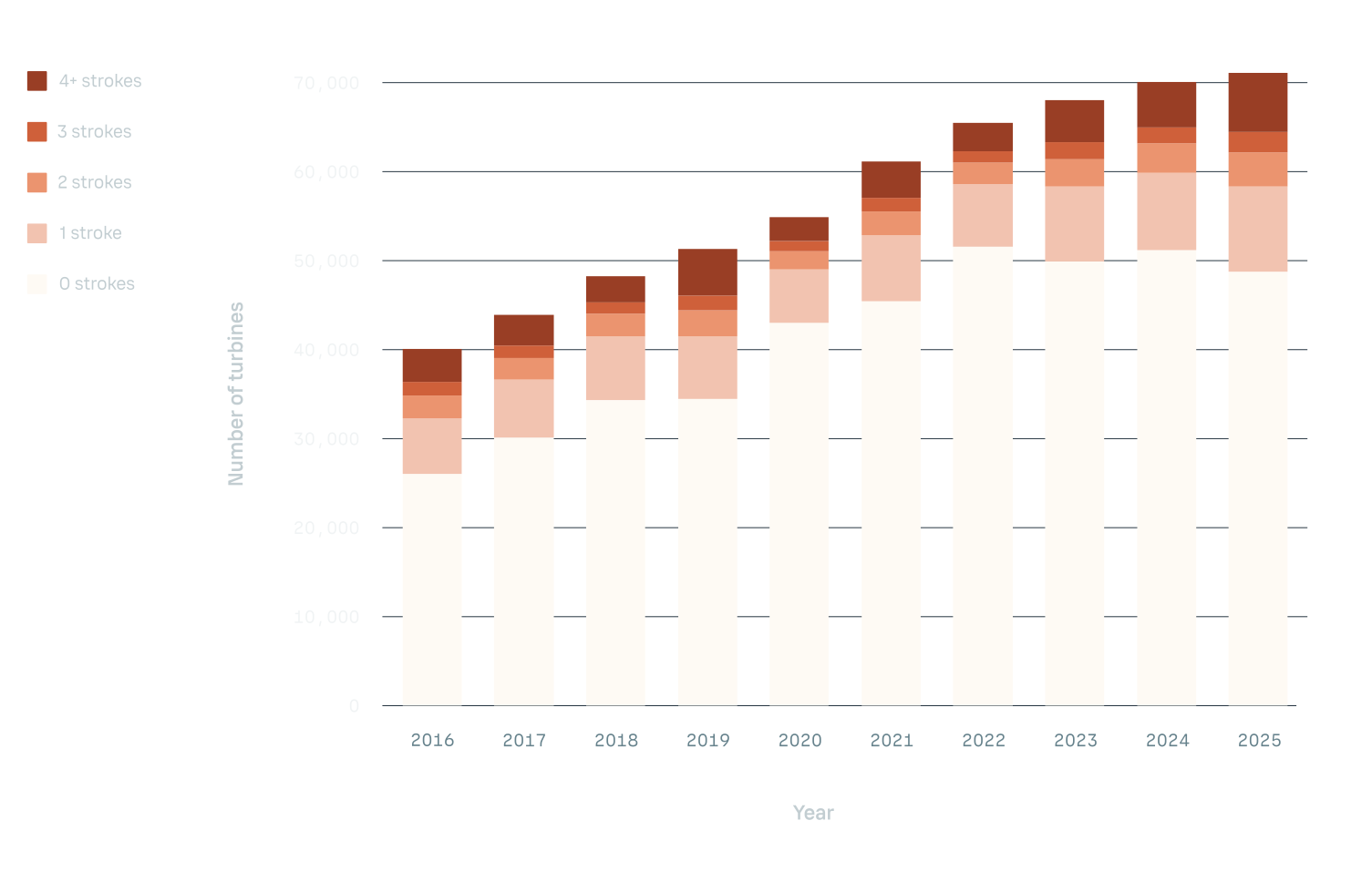
9.4 %
of turbines had 4 or more cloud-to-ground strokes in 2025
31.4 %
of turbines had at least one cloud-to-ground stroke in 2025
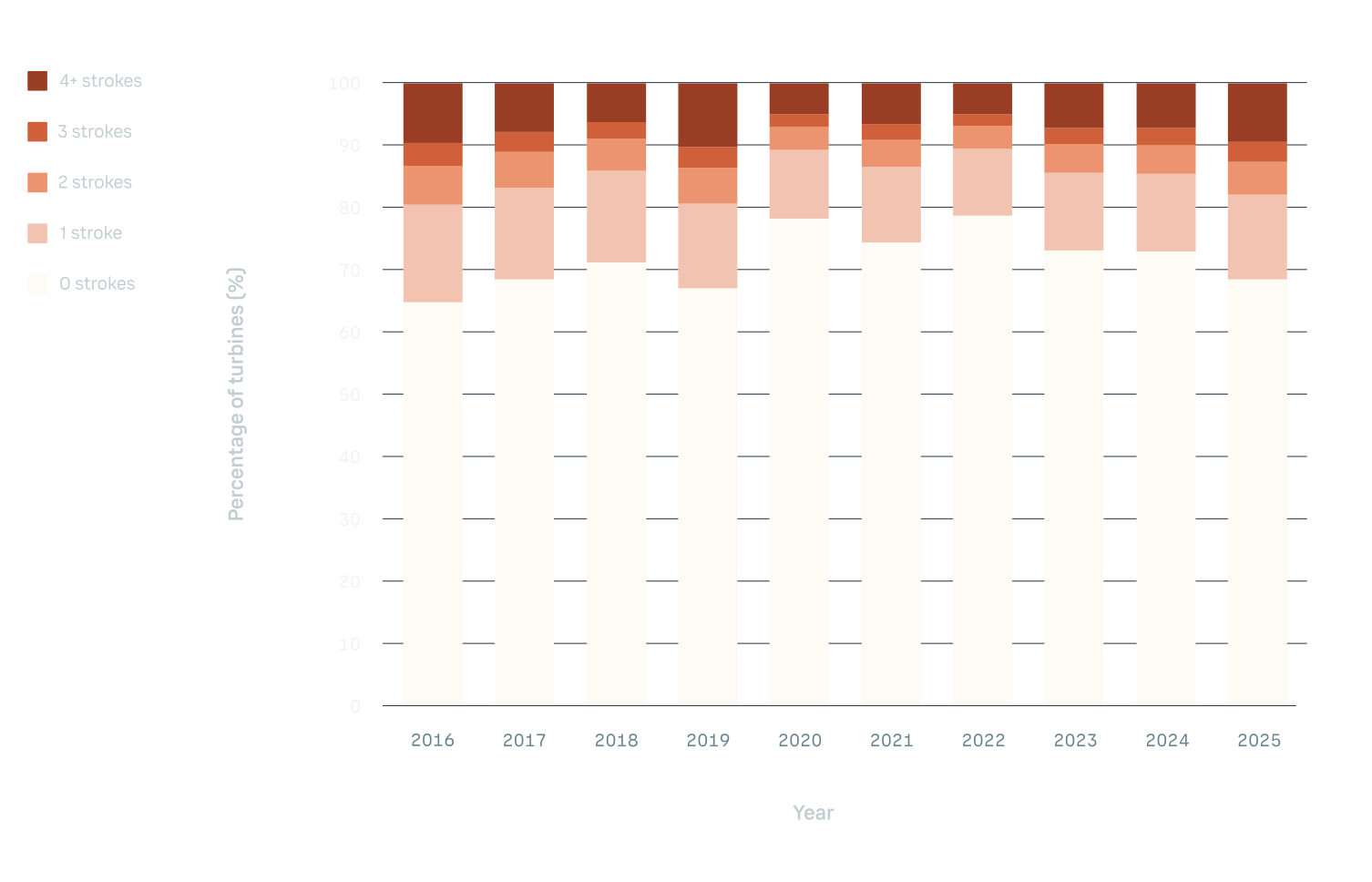
9.4 %
of turbines had 4 or more cloud-to-ground strokes in 2025
31.4 %
of turbines had at least one cloud-to-ground stroke in 2025
Open-air stadiums
Stadium lightning safety
Open-air stadiums with most lightning within a 10-mile radius
Major US stadiums concentrate tens of thousands of spectators in exposed environments during peak lightning season, creating unique safety challenges. Managing lightning at such facilities requires precise risk assessment and rapid response protocols.
Top 20 major open-air stadiums in the US by the total amount of lightning in 2025, within a 10-mile radius—the NFL’s official threshold for delaying play.
Kyle Field
Texas
159,298
Donald W. Reynolds Razorback Stadium
Arkansas
131,144
Tiger Stadium
Louisiana
128,847
Cotton Bowl
Texas
124,940
EverBank Stadium
Florida
117,677
Gaylord Family Oklahoma Memorial Stadium
Oklahoma
117,585
AT&T Stadium
Texas
114,374
Raymond James Stadium
Florida
93,839
Hard Rock Stadium
Florida
90,206
Vaught–Hemingway Stadium
Mississippi
82,185
Kyle Field
Texas
159,298
Donald W. Reynolds Razorback Stadium
Arkansas
131,144
Tiger Stadium
Louisiana
128,847
Cotton Bowl
Texas
124,940
EverBank Stadium
Florida
117,677
Gaylord Family Oklahoma Memorial Stadium
Oklahoma
117,585
AT&T Stadium
Texas
114,374
Raymond James Stadium
Florida
93,839
Hard Rock Stadium
Florida
90,206
Vaught–Hemingway Stadium
Mississippi
82,185
Doak S. Campbell Stadium
Florida
75,094
NRG Stadium
Texas
67,146
Bryant–Denny Stadium
Alabama
55,914
Ben Hill Griffin Stadium
Florida
54,991
Legion Field
Alabama
52,026
Nissan Stadium
Tennessee
49,986
Darrell K Royal Texas Memorial Stadium
Texas
49,067
GEHA Field at Arrowhead Stadium
Missouri
44,026
Mercedes-Benz Stadium
Georgia
37,863
M&T Bank Stadium
Maryland
36,201
Total warning hours due to lightning activity
The standard NFL rule is to delay play when lightning is detected within 10 miles of the stadium and to wait 30 minutes after the last strike before resuming. Because this 10-mile radius extends in all directions, a storm may need to move as much as 20 miles to fully clear the strike zone.
The table below shows the top 20 open-air stadiums with the longest lightning-related warning times, measured in hours.
Hard Rock Stadium
Florida
325
Tiger Stadium
Louisiana
316
Raymond James Stadium
Florida
309
Doak S. Campbell Stadium
Florida
264
NRG Stadium
Texas
251
EverBank Stadium
Florida
247
Ben Hill Griffin Stadium
Florida
235
Donald W. Reynolds Razorback Stadium
Arkansas
229
Vaught–Hemingway Stadium
Mississippi
227
Bryant–Denny Stadium
Alabama
226
Hard Rock Stadium
Florida
325
Tiger Stadium
Louisiana
316
Raymond James Stadium
Florida
309
Doak S. Campbell Stadium
Florida
264
NRG Stadium
Texas
251
EverBank Stadium
Florida
247
Ben Hill Griffin Stadium
Florida
235
Donald W. Reynolds Razorback Stadium
Arkansas
229
Vaught–Hemingway Stadium
Mississippi
227
Bryant–Denny Stadium
Alabama
226
Legion Field
Alabama
223
Nissan Stadium
Tennessee
208
Gaylord Family Oklahoma Memorial Stadium
Oklahoma
203
AT&T Stadium
Texas
192
Kyle Field
Texas
189
Cotton Bowl
Texas
189
Jordan-Hare Stadium
Alabama
181
Mercedes-Benz Stadium
Georgia
167
Williams–Brice Stadium
South Carolina
154
Neyland Stadium
Tennessee
152
Transmission grid
Analyzing lightning's impact on the US transmission grid
Lightning is the most common cause of momentary outages
Lightning remains the most common cause of momentary outages across the United States transmission grid, challenging operators to maintain reliability across a vast and complex network. From early lightning detection systems to today’s advanced analytics, the way grid operators understand and respond to lightning threats has come a long way. By pinpointing strike locations and measuring intensity, operators can now target protection and reduce costly equipment failures. These advances are especially critical as the digital economy raises expectations for uninterrupted power.
Correlating transmission line faults with lightning strikes is crucial for the grid's efficient maintenance. Learn how to match an asset's fault timestamp to lightning data, identify towers and spans to inspect, and assess strike severity by watching our on-demand demo.
Expert insight from Terry Boston, Founder of Grid Protection Alliance
)
Terry Boston
Founder and Board Member of Grid Protection Alliance
Expert insight from Terry Boston, Founder of Grid Protection Alliance
For the 2025 issue of the Annual Lightning Report, we sat down with Terry Boston, Founder and Board Member of Grid Protection Alliance, to discuss the relationship between the modern electricity grid and lightning. Terry has spent his career at the center of the world’s biggest energy challenges. He’s explained grid reliability to Congress and the White House and built partnerships everywhere from South Africa to South Korea. Terry earned respect across the industry as he rose through the ranks at TVA (Tennessee Valley Authority), led PJM Interconnection (Pennsylvania-New Jersey-Maryland Interconnection), and served on influential boards that shape the future of power. When it comes to keeping the lights on, few people bring a broader or deeper perspective.
With his unmatched industry experience, Boston offers an insider’s look at how data-driven approaches are shaping the future of grid resilience amid nature’s unruly forces.
On the importance of the US transmission grid
)
Terry Boston
“The sheer scale of the US transmission grid speaks for itself: it spans about 500,000 miles—enough to wrap around the globe 100 times at the equator. That number alone hints at its unprecedented significance and the sheer scale of what we’re dealing with. When I worked at TVA, we had 16,000 miles of transmission line just in our system, and it would take three months of daylight hours to do a visual inspection by helicopter. ”
“The National Academy of Engineering, which was established back in the 1860s by Abraham Lincoln to advise the government on science and engineering matters, was once asked to list the most important engineering developments of the last century. Not surprisingly, electrification and the grid came out on top. Nothing has improved our standard of living more..”
The shift to science-based lightning monitoring
Terry Boston
“In the early days, we worked with Weyerhaeuser, a large paper manufacturing company in the forests of Mississippi. Their operations were so sensitive to lightning that they would shut down whenever they heard crackling on the AM radio or saw a storm front approaching on radar. ”
“That got us thinking: what if, instead of relying on a single antenna at a place like Weyerhaeuser, we used multiple antennas to triangulate the exact location of lightning strikes? By analyzing the intensity of the radio noise, we could reliably gauge the strength of each lightning stroke, measured in kiloamps.”
“As we began measuring both the occurrence and intensity of lightning, we discovered we could control many of our system operations in response to lightning activity. This shift from guesswork to science-based monitoring allowed us to make smarter decisions about where to place protection and how to respond to storms.”
From flickers to blackouts: Lightning’s unpredictable toll
Terry Boston
“Lightning is the most common cause of momentary outages. Let me share a few examples. The 1977 New York outage—this affected Long Island and some of the boroughs, though not Manhattan—was caused by lightning taking out two 345 kV lines and triggering a cascading event. Another, much larger in square miles, happened on June 25th, 1998, when a lightning strike in the Midwest caused a cascading failure that went all the way up into Manitoba.
The most expensive one that I’ve encountered involved the highest intensity lightning stroke ever measured on the TVA system—the Tennessee Valley Authority, which manages one of the largest public power systems in the United States. This was a 300 kA stroke. The lightning detection network in Tucson initially dismissed it as an error or noise because it was such a high-intensity event. But it actually tripped off two nuclear plants, and you’re talking one to two million dollars per unit per day in lost generation.”
Tracing the damage
Terry Boston
“Lightning damage isn’t limited to just the transmission line itself. When a high-intensity strike hits close to a substation, you have to worry about damage to transformers and other equipment, which can be costly and time-consuming to repair. On the lines themselves, the most common problem is tracking on the insulators—lightning leaves marks that reduce the insulation level, making the line more vulnerable to future strikes.”
“These days, with advances in fault location technology from organizations like the Grid Protection Alliance, we can pinpoint the likely fault location to within one or two structures. That means instead of searching miles of line, crews can go directly to the problem area, saving time and reducing the risk of extended outages.”
From "act of God" to act of data
Terry Boston
“The beauty of what we have now is that it’s all science-based. Long, long time ago, if there was a piece of equipment failure or a momentary outage, we’d just say, ‘Oh, that had to be lightning.’ There was a lot of guesswork, and lightning was often blamed for outages that might have had other causes. Now, with the lightning detection network, we can pinpoint exactly where and when a strike occurred. For example, we can say that at structure 1223, a 100-kA stroke hit, and we know the root cause of that outage.”
“Once we got enough antennas in place to measure lightning, we actually discovered that lightning didn’t cause as many outages as operators had assumed before. Other things—like trees brushing a line or falling in the forest—can cause faults that look similar but are actually different in nature. Today, we can use science and data to separate fact from assumption.”
On protecting the grid in a digital world
Terry Boston
“One of the most significant breakthroughs in grid protection has been our ability to actually measure lightning—both its location and its intensity—and use that data to decide exactly where to install metal oxide varistor lightning arresters. This targeted approach has dramatically reduced equipment failures across the network."
“But the world is changing fast. Today, we are in a digital economy, and even momentary outages are unacceptable for the quality of power we deliver. The grid’s performance has improved, but the demands on it are only growing. The importance of not having interruptions, both momentary and extended, on the grid is greater than ever. As we look to the future, we need to keep pushing for even better data, smarter analytics, and more resilient infrastructure to meet the needs of a world that depends on uninterrupted power.”
On preparing for the unpredictable
Terry Boston
“After the ’77 blackout, operators in places like New York started rearranging generation as storms approached—a strategy known as contingency analysis. The goal is to always run the system so that if any single element fails, customers won’t lose power; we call this operating under N-1 conditions.”
“More and more often, operators rely on real-time weather and lightning data in their control centers, watching the lightning flash density before it gets to their system, knowing it’s going to put the grid at risk."
Lightning density across the US transmission grid
The hot spots
Both Daytona Beach, FL, and Lake Charles, LA, have seen a significant increase in lightning in 2025 compared to the 2016–2024 average—exceeding 12 flashes per km².
Windy City strikes
Greater Chicago experienced a significant increase in lightning density around its transmission grid in 2025.
Global maps
Global lightning maps 2025
Our global lightning data comes from GLD360: a Vaisala-owned long-range detection network capable of locating lightning anywhere on the planet with a median accuracy of 1 km. As the only truly global network, GLD360 delivers the most consistently accurate and reliable lightning data worldwide.
- 2.01 billion
total lightning events detected in 2025
- 829 km
is the fresh world record for the longest ligntning flash
- 158 / km²
Kuala Lumpur, as the federal territory within Malaysia, had the highest average lightning density in the world for any sub-country area. Even higher than any region in Singapore.
Global lightning maps
)
The longest lightning flash ever
In 2025, a new world record for the longest lightning flash was established. 829km (515 miles) long "megaflash" occurred in the US on October 22nd, 2017, extending from eastern Texas to Kansas City. The data was revisited in 2025, confirming the new record. Xweather detected more than 160 cloud-to-ground strokes contacting the ground beneath the “megaflash.”
)
Thunder days & thunder hours
Climatologists used to rely on human observers to record a thunder day when they heard thunder at their location.This map combines modern technology with the old method to show thunder hours for every location on Earth by counting every hour in which two or more lightning events were detected within 15 km of the center of each 0.05 × 0.05-degree grid (approximately 5 km by 5 km).
For media
Media kit available here.
Want to make sure you’re using the assets correctly or request specialized datasets? Looking to arrange an interview with one of our experts?
Don’t hesitate to get in touch for more data presented in the Annual Lightning Report.
Xweather lightning data in press
)
)
Previous reports
)
The Annual Lightning Report. Total lightning statistics for 2024
Go to report)
The Annual Lightning Report. Total lightning statistics for 2023
Go to report)